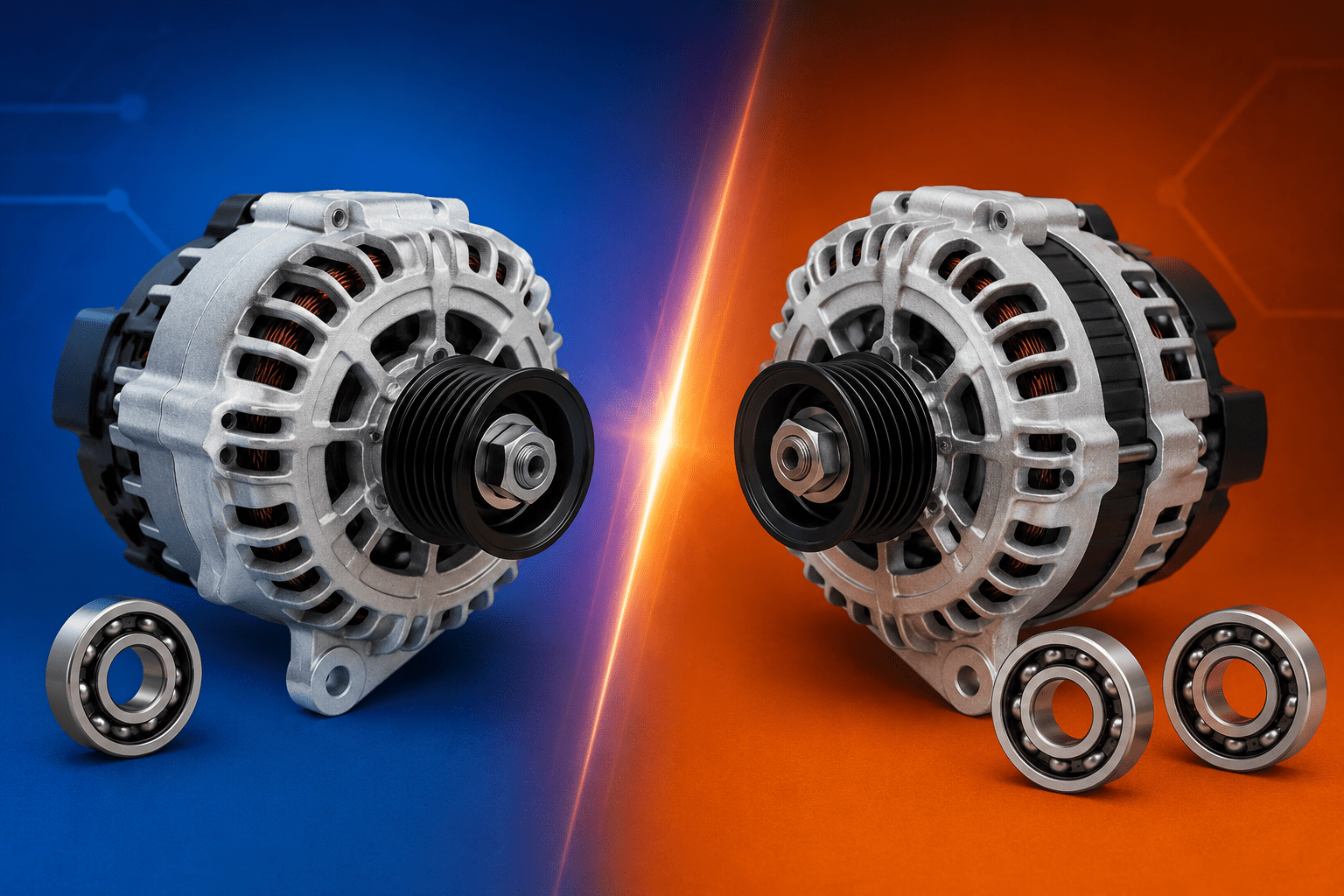
Single Bearing vs Double Bearing Alternators comes down to one thing: how the rotor gets its support. A single bearing alternator borrows the engine’s bearing to hold the rotor, while a double bearing alternator carries two bearings of its own.
That design choice ripples into mounting, alignment, and maintenance across industries in cities like Jaipur, Pune, and Ahmedabad. Here’s a full breakdown of Single Bearing vs Double Bearing Alternators.
What Is the Difference Between Single Bearing vs Double Bearing Alternators?
One bearing versus two – that’s the short answer. A single bearing alternator bolts straight onto the engine flywheel; a double bearing alternator connects through a coupling instead.
Single bearing units sit right against the engine, so flywheel alignment has to be precise or vibration becomes a problem fast. Double bearing units sit on their own frame, giving installers more room for error.
Weight tells the same story. Part of the rotor’s load in a single bearing alternator gets carried by the engine bearing, while a double bearing alternator’s own housing takes the full load. That detail separates the two designs in Single Bearing vs Double Bearing Alternators comparisons.
How Does a Single Bearing Alternator Work?
It works by letting the engine do half the job. The flywheel and crankshaft support one end of the rotor, so there’s no separate coupling or extra bearing housing to fit.
Fewer parts means faster assembly, which is why compact gensets lean on this design so often. A single bearing alternator takes up less space, one of the practical trade-offs buyers weigh in Single Bearing vs Double Bearing Alternators decisions.
This is also where the single bearing side pulls ahead in most comparisons for smaller equipment – nothing beats it for simplicity.
What stands out about a single bearing alternator:
- Lighter build overall
- Quicker to mount on standard engines
- Lower upfront cost
- Needs precise flywheel alignment
How Does a Double Bearing Alternator Work?
Here, the rotor gets its own two bearings and does not lean on the engine at all. A flexible coupling links it to the engine instead of a direct bolt-on.
That independence is the whole advantage. Heavier loads, longer run times, more vibration – none of it transfers back to the flywheel. Plants running equipment ten or twelve hours a day pick this setup for that reason.
It’s arguably the sharpest contrast point in Single Bearing vs Double Bearing Alternators once continuous-duty operation enters the picture.
A double bearing alternator generally offers:
- Stronger performance under sustained heavy load
- Easier servicing without touching the engine
- Better stability during vibration or load shifts
- Compatibility across a wider range of engine types
Single Bearing vs Double Bearing Alternators: Which One Performs Better?
Neither one is simply “better” in Single Bearing vs Double Bearing Alternators. It depends on the load and how many hours the unit runs.
| Feature | Single Bearing Alternator | Double Bearing Alternator |
| Support Structure | Shares engine bearing | Uses its own two bearings |
| Installation | Direct flywheel mount | Coupling-based mount |
| Best Suited For | Compact, portable gensets | Industrial, continuous-duty gensets |
| Maintenance | Tied to engine servicing | Independent servicing |
| Cost | Generally lower | Generally higher |
Short runs, mobile setups, tighter budgets – a single bearing alternator handles those well. Long shifts and heavy industrial loads are where a double bearing alternator earns its higher price tag, and that pattern shows up again and again in Single Bearing vs Double Bearing Alternators reviews.
Where Are Single Bearing vs Double Bearing Alternators Used?
Mostly, single bearing units end up in smaller and portable gensets, and double bearing units run the bigger industrial backups.
Walk through a construction site in Jaipur or Chennai and single bearing alternators show up often – quick to set up, easy to move. Manufacturing plants and hospitals lean the other way, since double bearing alternators run around the clock without wearing down the engine’s bearing.
Rental power companies almost always go double bearing too, since these units swap between engines without compatibility headaches – one more real-world signal in Single Bearing vs Double Bearing Alternators usage data.
Which Option Should You Choose Between Single Bearing vs Double Bearing Alternators?
Go single bearing if the budget is tight and the load stays light. Go double bearing once the load turns heavy or the generator runs long stretches. Check daily run time, total load, mounting space, and long-term maintenance budget before deciding.
Buyers who want something straightforward and affordable usually land on a single bearing alternator, while buyers planning for years of heavy industrial use go double bearing instead. Atop Generators has a detailed single bearing alternator lineup worth checking before deciding.
Match the choice to the actual power requirement, not the price tag, and Single Bearing vs Double Bearing Alternators stops being a hard decision.
What Do People Usually Ask About Single Bearing vs Double Bearing Alternators?
Which lasts longer, a single bearing or a double bearing alternator?
Double bearing alternators typically outlast single bearing units under continuous use.
Can a single bearing alternator handle heavy industrial loads?
It manages moderate loads, but double bearing units hold up better under sustained heavy use.
Is a double bearing alternator harder to install?
Slightly – it needs proper coupling alignment with the engine, which takes extra setup time.
Which type costs less to buy?
Single bearing alternators are usually cheaper thanks to their simpler design.
Which one should a small business pick?
A single bearing alternator fits small businesses with lower, occasional power needs best.