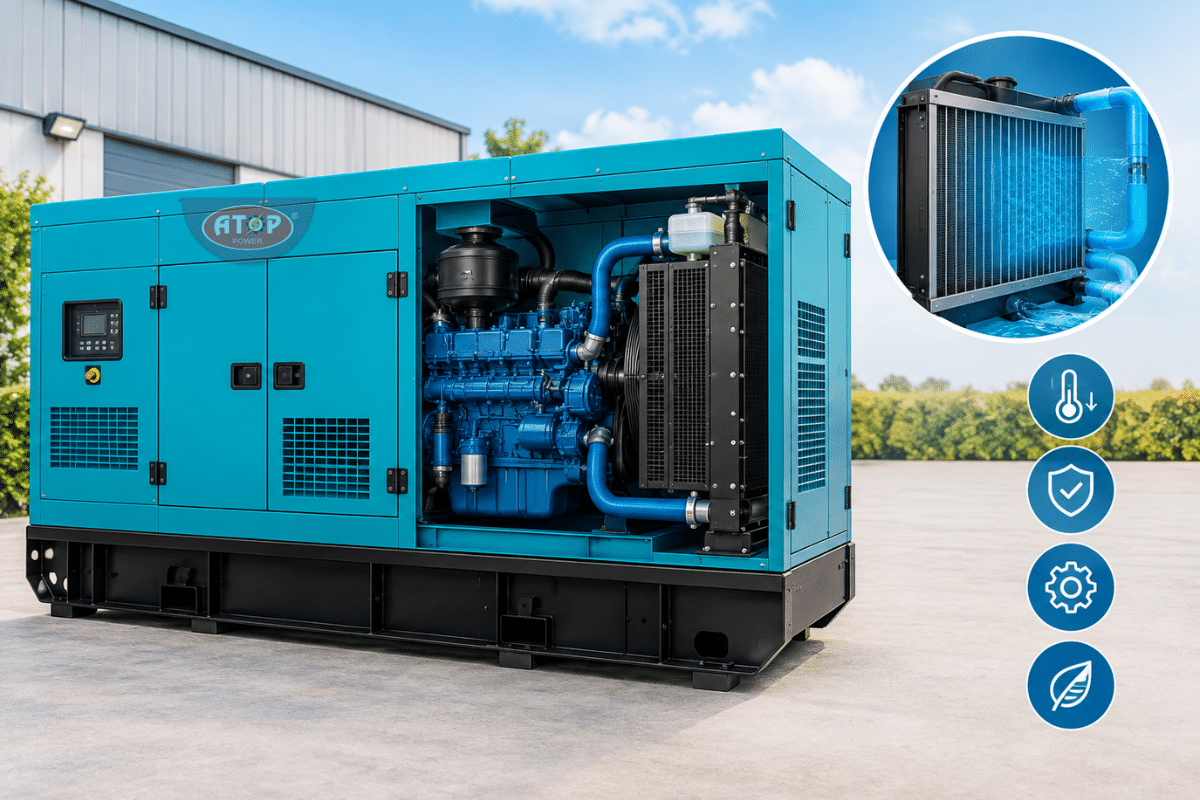
Quieter operation, better heat control, and the ability to run for hours without strain – that’s the short answer for why water-cooled diesel generators win out over air-cooled units whenever the load is heavy or continuous. Once you understand how the cooling actually works, the rest of the comparison falls into place fairly easily.
What Makes Water-Cooled Diesel Generators Different From Air-Cooled Ones?
The cooling method is the whole story. Water-cooled diesel generators push coolant through the engine block to carry heat away, whereas air-cooled units just rely on fans blowing over the engine’s surface.
That gap becomes obvious during long runs. An air-cooled engine starts feeling the strain well before a water-cooled one even approaches its limit.
A few differences stand out immediately:
- Coolant circulation instead of open-air fan cooling
- Temperatures that stay steadier through extended use
- Less noise overall, since large cooling fans aren’t needed
- Far better tolerance for continuous, heavy-load work
Why Do Water-Cooled Diesel Generators Run So Much Quieter?
They run quieter mainly because water-cooled diesel generators skip the large, high-speed fans that air-cooled engines need for cooling. Coolant handles the heat removal instead of moving air around.
That’s part of why hospitals, residential complexes, and offices near living spaces so often choose them. Fewer complaints, fewer restrictions on run times – a quieter genset just causes less friction all around.
Where noise rules are particularly strict, Water Cooled Silent Gensets tend to be the go-to choice, since these models are built to keep sound down without giving up on power.
How Do Water-Cooled Diesel Generators Handle Extended Runtimes?
Steady coolant flow is what allows water-cooled diesel generators to run for hours without hitting the overheating issues air-cooled engines eventually face. Temperatures stay far more even across the entire duty cycle.
This matters most where outages stretch on for a long time, or where the generator ends up carrying the main load instead of just backing things up. Factories, data centers, and large housing complexes fall right into that bracket.
A few advantages show up clearly during long runs:
- Engine temperature that stays stable for hours
- Lower risk of thermal shutdown under continuous load
- Fuel efficiency that improves once the engine settles in
- Longer gaps between required maintenance checks
Water-Cooled vs Air-Cooled Diesel Generators: How Do They Actually Compare?
On noise, runtime, and heat control, water-cooled diesel generators come out ahead, though air-cooled models still hold the edge on upfront cost and simplicity. Which one makes sense really depends on how the generator gets used day to day.
|
Factor |
Water-Cooled Diesel Generators |
Air-Cooled Diesel Generators |
|
Noise level |
Lower | Higher |
|
Ideal duty cycle |
Continuous, heavy load |
Short-term, intermittent |
|
Heat management |
Consistent | Less consistent |
| Maintenance complexity | Slightly higher |
Lower |
| Initial cost | Higher |
Lower |
An air-cooled unit might be all that’s needed for occasional backup. But anything running for hours at a stretch tends to favour the water-cooled option instead.
What Maintenance Do Water-Cooled Diesel Generators Actually Need?
Coolant checks, radiator cleaning, and the odd hose inspection are really what keep water-cooled diesel generators reliable over time. None of it is difficult, but it does need to stay on schedule.
A reasonable routine looks something like this:
- Check coolant levels every few weeks
- Inspect hoses and clamps for leaks or wear
- Clean the radiator to keep dust from building up
- Replace coolant on the schedule the manufacturer recommends
Skip these even occasionally, and the engine’s lifespan tends to shrink faster than most owners expect.
Are Water-Cooled Diesel Generators Worth the Higher Upfront Cost?
For heavy or continuous use, yes – the extra upfront cost of water-cooled diesel generators usually comes back through better fuel efficiency and fewer breakdowns down the line. For occasional or short-term use, that price gap is harder to justify.
Sites running generators for several hours a day tend to recover the difference within a year or two, mostly through lower maintenance and less downtime. Before comparing Water Cooled Silent Gensets against a standard air-cooled model on price alone, it’s worth working out total operating hours first.
Which Industries Rely Most on Water-Cooled Diesel Generators?
Hospitals, data centers, manufacturing plants, and large residential complexes depend on water-cooled diesel generators the most, largely because these sites simply cannot tolerate frequent power gaps or excessive noise. Reliable, continuous output ends up mattering more here than the initial price tag.
Construction sites and commercial buildings near residential areas also lean toward Water Cooled Silent Gensets, since local noise restrictions often rule out louder alternatives from the start.
FAQs
Are water-cooled diesel generators more expensive to maintain?
Slightly, since the coolant system needs periodic checks, though the cost stays manageable with regular servicing.
Can water-cooled diesel generators run continuously for days?
Yes, they are built for extended runtimes far better than most air-cooled alternatives.
Do water-cooled generators need more space than air-cooled ones?
Generally yes, since the cooling system requires additional components like a radiator setup.
Are Water Cooled Silent Gensets suitable for residential areas?
Yes, their lower noise output makes them well suited to noise-sensitive residential locations.
How often should coolant be checked in these generators?
Coolant levels should be checked every few weeks, with full changes done as per the manufacturer’s schedule.
Contact us on Whatsapp today for more details and expert assistance!